Wildberries Warehouses Targeted by Ukrainian Attack Drones
 By Robin Pattinson · Sep 8, 2026 · 3 min read
Russia’s warehouse and fulfillment infrastructure is emerging as a new target in Ukraine’s long-range drone campaign, highlighting a physical security risk that warehouse operators have rarely had to incorporate into conventional resilience planning.
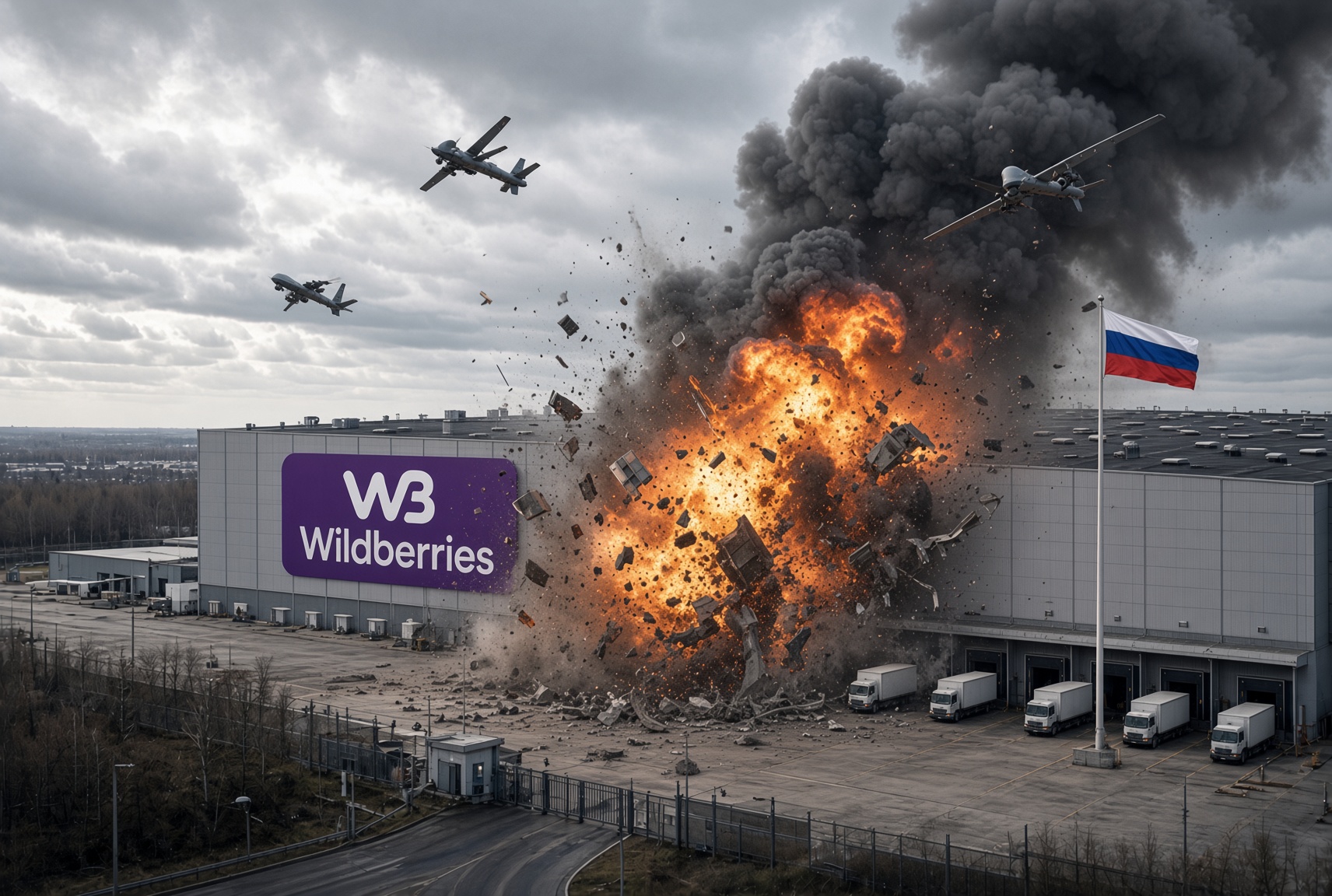
Ukrainian attack drones have reportedly struck logistics facilities operated by Wildberries, Russia’s largest e-commerce marketplace, across multiple regions during the past month. The reported attacks represent a shift from the energy, industrial and military infrastructure that has dominated Ukraine’s deep-strike campaign toward large civilian logistics nodes.
For warehouse professionals outside the conflict zone, the significance lies in the concentration risk exposed by the attacks: when enormous volumes of inventory and fulfillment capacity are consolidated into a relatively small number of distribution centers, individual buildings become critical nodes in the wider supply chain.
23 Logistics Facilities Reportedly Hit
At least 23 of Wildberries’ 30 logistics complexes have reportedly been struck, with attacks reported in the Moscow region, St. Petersburg, Tula, Volgograd, Perm, Krasnodar and Samara. At least 20 facilities reportedly sustained severe damage, while some were destroyed. By August 5, 11 logistics complexes covering approximately 1.4 million square meters had been permanently closed, with at least nine additional sites significantly damaged.
One major attack reportedly hit Wildberries’ Elektrostal facility outside Moscow on July 18. At approximately 230,000 square meters, it was described as the company’s second-largest logistics complex in Russia. The scale matters because Wildberries is deeply embedded in Russian distribution. The marketplace reportedly accounts for approximately 45% of the country’s e-commerce market, handles millions of orders per day and serves 79 million customers monthly. Annual sales are estimated at $68 billion. Its infrastructure also connects approximately 100,000 small businesses to consumers and supports a network of around 95,000 collection points.
Inventory Losses Move Downstream
The physical destruction has reportedly translated quickly into fulfillment disruption.
Consumers in Moscow and other major cities have experienced delivery delays lasting weeks, widespread order cancellations and price increases for some products. Small and midsize merchants that concentrated inventory inside Wildberries facilities have faced another problem: the destruction of stock held inside the affected warehouses.
Wildberries founder and CEO Tatyana Kim said the company was using backup systems and supply chain rerouting to limit disruption.
“The attack on Wildberries infrastructure is an attack on civilians,” Kim said. She said businesses from Russia, Kyrgyzstan, Belarus, Kazakhstan, Armenia, Uzbekistan and China had suffered losses.
Wildberries has reportedly added drone attacks, shelling and explosions to the force majeure provisions in its terms, potentially limiting its obligation to compensate sellers for destroyed inventory. The company subsequently announced partial assistance for some affected merchants.
A New Dimension of Warehouse Resilience
The attacks demonstrate an extreme version of a familiar warehouse resilience problem.
Large automated fulfillment centers deliver economies of scale, inventory consolidation and high throughput, but concentrating operations also concentrates risk. Losing a 200,000-square-meter distribution center cannot necessarily be offset simply by diverting trucks to another building. Alternative facilities need available storage, labor, material-handling capacity, systems connectivity and transportation capacity.
The risk may also extend beyond Wildberries. On July 31, Ukrainian drones reportedly struck a shipping warehouse in Zelenodolsk, Tatarstan, close to a facility operated by Ozon, Russia’s second major e-commerce marketplace, which reportedly holds approximately 32% of the market.
For warehouse operators in Western markets, drone warfare may remain an exceptional scenario. The operational lesson is considerably broader: resilience depends not only on protecting individual buildings, but on understanding how quickly inventory, fulfillment volume and transportation flows can be redistributed when a major logistics node suddenly becomes unavailable.