
Thermal Monitoring Alone Won't Contain Battery Fires
A missed thermal alarm in a mixed-cargo warehouse storing consumer electronics alongside apparel and groceries does not just trigger a false response. It erodes operator confidence in detection systems, creating hesitation that can delay intervention when a genuine lithium-ion thermal runaway event begins. Under the stricter 2026 fire safety codes, logistics operators face a dual challenge: deploying high-sensitivity monitoring that catches abnormal heating early without generating disruptive false alarms that condition personnel to ignore warnings during actual emergencies.
According to QBE research analyzing UK fire service data, lithium-ion battery fires surged 147% between 2022 and 2025, with 23% of incidents occurring in commercial properties where batteries are increasingly distributed throughout mixed inventory. The detection challenge extends beyond warehouses: tracking data compiled by Resource Recycling documented 448 reported fires at waste and recycling facilities in 2025 alone, underscoring how battery proliferation across supply chains is outpacing legacy detection infrastructure designed for conventional combustibles.
The operational friction is structural. Lithium-ion batteries now arrive distributed throughout general inventory rather than segregated into dedicated storage zones, complicating detection and containment. Temperature anomalies from normal warehouse activity such as sunlight exposure through dock doors or heat from adjacent mechanical equipment can mimic early-stage thermal events, forcing operators to balance sensitivity against operational continuity. According to the National Fire Protection Association's 2025 hazardous materials storage guidance, warehouses handling lithium-ion products must implement layered fire protection strategies that combine continuous monitoring, physical separation, and suppression systems calibrated to the specific battery chemistries and packaging configurations present in the facility.
Balancing Detection Sensitivity With Operational Continuity
Todd Faulkner, iEFD / iCM Sales at MoviTHERM, a provider of thermal monitoring systems, explained the technical tradeoffs in written responses to The Supply Chainer. "The key to balancing early detection with false-alarm prevention is applying intelligent thermal monitoring that distinguishes meaningful temperature anomalies from normal warehouse activity. When properly designed and commissioned for the specific environment, the system can provide reliable early warning while minimizing unnecessary operational disruptions. The objective is to give personnel actionable time to investigate and isolate a developing problem before it escalates. System design, camera placement, commissioning, and periodic review are just as important as the sensitivity of the detector itself."
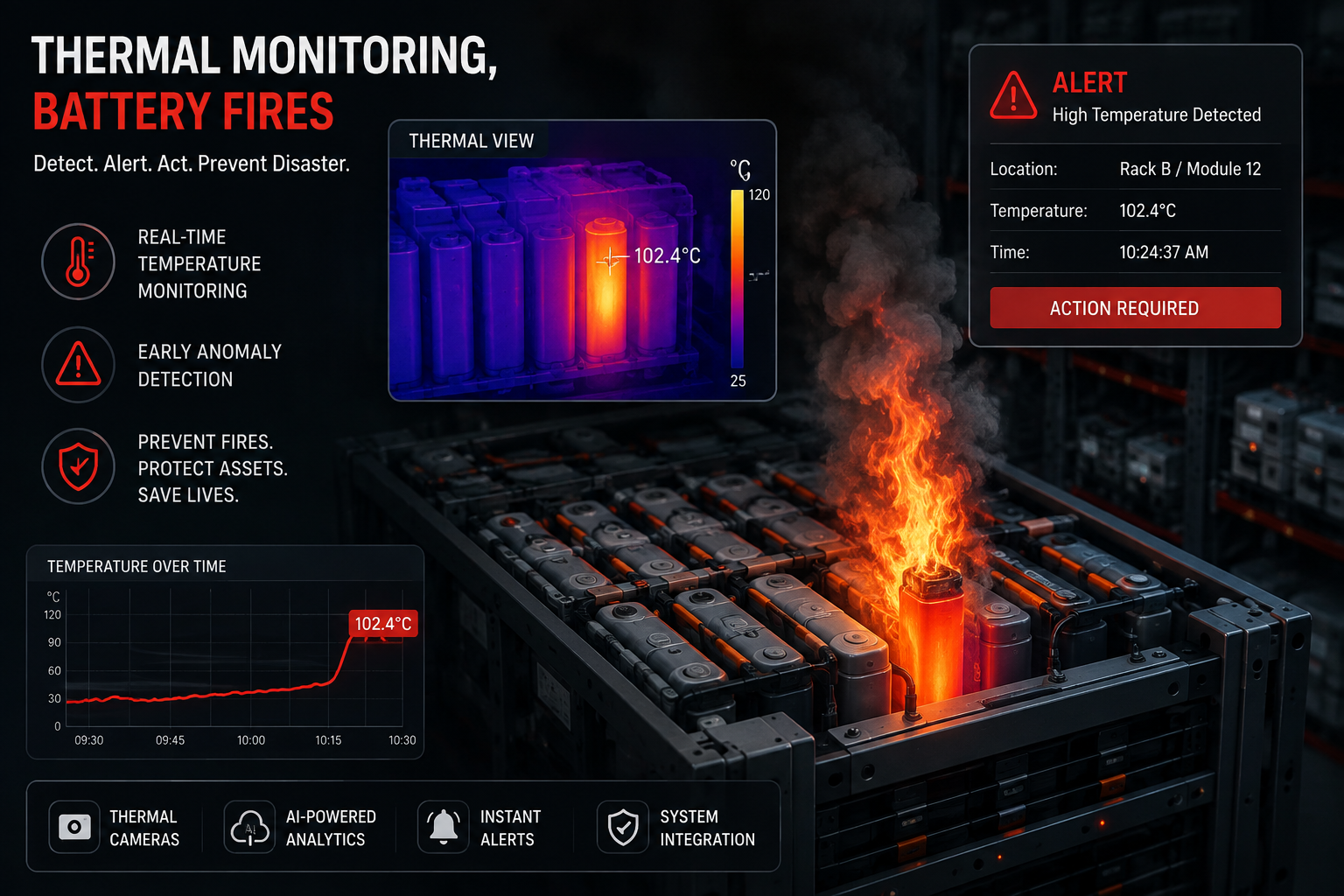
The containment requirements extend beyond sensor placement. Physical barriers, aisle spacing, fire-rated compartmentation, and dedicated quarantine areas for damaged or recalled batteries form the structural foundation that limits propagation after a thermal event begins. Continuous thermal monitoring provides early warning, but cannot substitute for code-required sprinkler systems, smoke and gas detection, ventilation protocols, or coordinated emergency response procedures developed with the facility's fire protection engineer and insurer.
Risk-Based Design Anchored in Actual Hazard Profiles
The most effective strategies are risk-based rather than uniform. Operators must first map where lithium-ion batteries enter the facility, how they are packaged and stored, how long they remain onsite, and whether damaged or returned products follow separate handling protocols. Monitoring and containment can then be designed around the facility's actual hazards rather than applying a single approach throughout the warehouse. Complementary measures include separating battery inventory from general merchandise, limiting quantities stored within each area, using noncombustible containers where applicable, and coordinating the design with the authority having jurisdiction.
Autonomous vehicle deployment introduces parallel challenges around real-time oversight and incident response that cannot rely on driver feedback. "Autonomous fleets require new oversight and maintenance structures compared to driver-based fleets. The operational processes that must be redesigned first at platform level are real-time remote monitoring and intervention systems, predictive maintenance workflows that rely on vehicle telemetry rather than driver feedback, and incident response protocols that integrate autonomous vehicle logs with regulatory reporting frameworks," Jevgeni Kabanov, President and Head of Autonomous Driving at Bolt, as previously told to The Supply Chainer. Without foundational monitoring and response layers, scaling becomes operationally unsustainable across distributed mixed-use environments.
Containment and monitoring serve different but complementary purposes. Physical separation helps limit propagation after an event begins, while continuous thermal monitoring can identify abnormal heating early enough for personnel to investigate and potentially isolate the affected material before it involves adjacent inventory.